A Report on IODGlobal Webinar: Leaders' Perspectives on Rebuilding Indian Workplaces

The Institute of Directors (IOD), India, in collaboration with Gallup, hosted a Global Webinar which examined how trust, managerial effectiveness and organisational values shape the future of Indian workplaces.
Sustainable organisational performance depends not only on strategy, but on how leaders build trust, enable people to contribute and bring organisational values to life every day. At the IOD-Gallup Global Webinar, themed 'Leaders' Perspectives on Rebuilding Indian Workplaces: From Insights to Actions', distinguished leaders and industry experts examined the widening gap between organisational aspirations and employees' everyday experiences. Drawing on IOD and Gallup's joint report, Rebuilding Indian Workplaces for the Future, and their own leadership journeys, the speakers explored how disengagement, managerial effectiveness, fairness and trust influence organisational resilience and sustainable performance.
From the boardroom's responsibility to scrutinise people-related data to the manager's role in enabling individual potential, the discussions underscored a common imperative that culture cannot remain a statement of intent; it must be reflected in leadership conduct, workplace relationships and everyday decisions. The central message was clear: Rebuilding Indian workplaces requires more than diagnosing disengagement. It calls for a sustained commitment to creating environments where people feel valued, trusted and empowered to contribute, enabling organisations to transform employee engagement into enduring institutional strength and business performance.
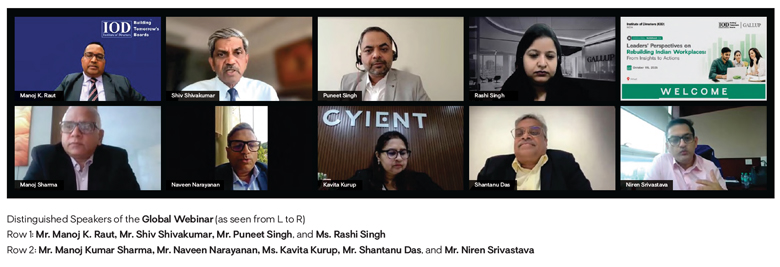
The 'Opening Remarks' were delivered by:
Mr. Manoj K. Raut
CEO & Secretary General
Institute of Directors (IOD), India
Mr. Raut noted that IOD, in partnership with Gallup, hosted its second collaborative webinar, focusing on workplace culture, employee engagement and the evolving responsibilities of organisational leaders. He emphasised the need for organisations to respond to changing employee expectations around work-life balance, flexible working, meaningful careers and well-being, while adapting to AI and new ways of working. He posed a pertinent question: “How can we rebuild Indian workplaces not merely for the future, but to shape the future of workplaces?” Mr. Raut warmly welcomed the distinguished speakers and encouraged participants to reflect on the evolving dynamics of the workplace. Finally, emphasising that workplace culture is a core boardroom concern, he urged participants to explore how employee engagement and empowerment could strengthen organisational resilience and support long-term performance.
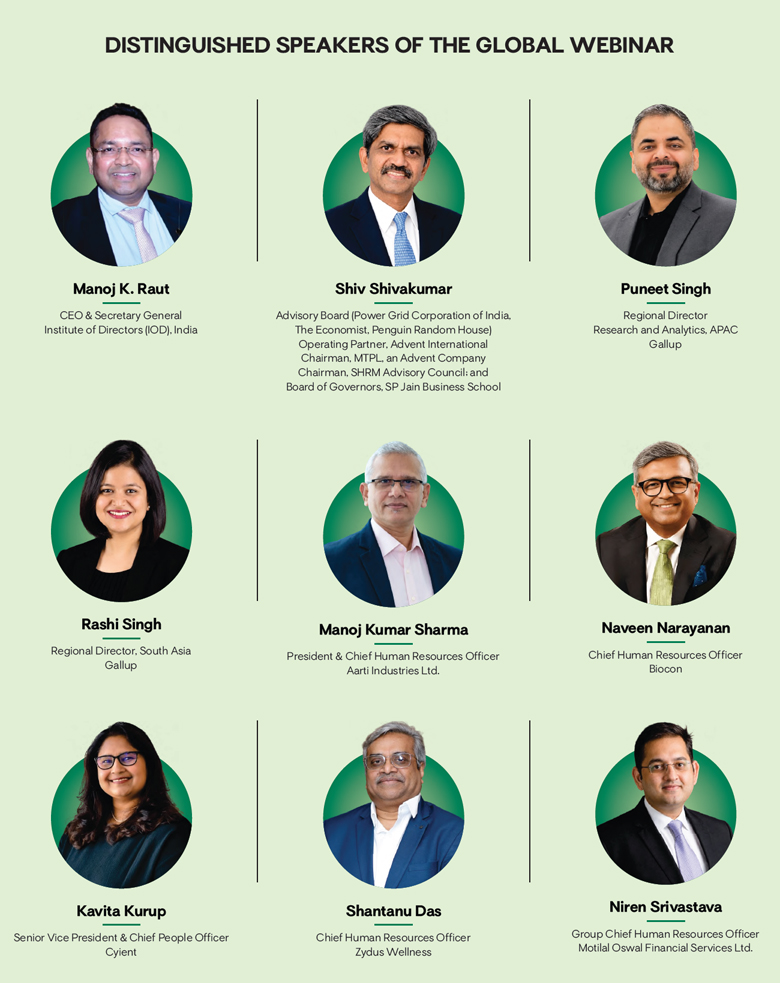
The 'Keynote Address' was delivered by:
Mr. Shiv Shivakumar
Advisory Board (Power Grid Corporation of India,
The Economist, Penguin Random House)
Operating Partner, Advent International
Chairman, MTPL, an Advent Company
Chairman, SHRM Advisory Council; and Board of Governors, SP Jain Business School
Mr. Shivakumar described Culture as “the smell of the organisation”, arguing that it is best understood by observing how people interact in meetings. Open discussion, constructive disagreement, mutual respect and accountability, he noted, reveal far more about an organisation's culture than formal declarations. He emphasised that employees seek three things beyond salary and titles: (i) Confidence in the organisation's direction; (ii) Supportive colleagues, and (iii) Opportunities for growth through meaningful feedback and recognition. Citing Gallup's findings, he highlighted India's low employee engagement and its substantial economic cost, alongside concerns about managerial disengagement, cultural misalignment and organisational resilience. He distinguished between accountability driven by fear and that fostered by institutional loyalty, stressing that employees must feel responsible for the organisation rather than merely its leaders. Addressing directors, he urged boards to challenge people-related data, understand employee perspectives, strengthen fair appraisal systems and make people a standing priority on board agendas. Sharing Nokia's practice of linking executive compensation to both performance and values-based behaviour, he underscored that culture must be reinforced through leadership conduct and meaningful consequences. He left everyone with a clear message: Boards must move beyond identifying problems, to actively building workplaces where people feel engaged, valued and accountable.
The 'Gallup Report Highlights' were presented by:
Mr. Puneet Pratap Singh
Regional Director - Research & Analytics, APAC
Gallup
Mr. Singh used the analogy of a boat carrying 100 employees to illustrate India's engagement landscape. In the analogy, 23 engaged employees rowed with conviction, 59 "not engaged" employees contributed primarily out of compliance, and 18 actively disengaged employees rowed against the organisation's direction. He highlighted the growing proportion of "not engaged" employees, whose relationship with work had become transactional, often where organisational values were professed but not practised. Gallup's findings also highlighted the pivotal influence of managers, who account for 70% of the variation in team engagement. Drawing on insights from 181 IOD members and 27 in-depth conversations, he highlighted three findings from the IOD member survey: (i) Aligning workplace experiences with stated values; (ii) Fostering teams in which people support and rely on one another, and (iii) Selecting managers for talent and role fit rather than solely on past performance. He then outlined four connected priorities through the Gallup Path: (i) Select, equip and support great managers; (ii) Put talent where it performs best; (iii) Bring culture to life every day; and (iv) Turn engagement into stakeholder value. He stressed that these priorities are interconnected and must translate into everyday leadership practice. The discussion further invited leaders to move beyond diagnosing disengagement towards building workplaces where trust, empowerment and collective performance enable both people and organisations to thrive.
PLENARY SESSION
The Session was moderated by:
Mr. Puneet Pratap Singh
Regional Director - Research & Analytics, APAC
Gallup
The Session had the following speakers:
1. Manoj Kumar Sharma
President & Chief Human Resources Officer
Aarti Industries
2. Niren Srivastava
Group Chief Human Resources Officer
Motilal Oswal Financial Services
3. Naveen Narayanan
Chief Human Resources Officer
Biocon
4. Shantanu Das
Chief Human Resources Officer
Zydus Wellness
5. Kavita Kurup
Senior Vice President & Chief People Officer
Cyient
6. Rashi Singh
Regional Director – South Asia
Gallup
Mr. Sharma emphasised that individual brilliance must be complemented by collective excellence. He explained that Aarti regards every employee as talent, giving equal importance to business outcomes and people development when assessing performance and readiness for greater responsibility. He highlighted, Aarti's emphasis on leadership beyond hierarchy, with hiring decisions involving leaders outside the relevant function to assess an individual's broader capabilities and aptitude for developing others. The Aarti Engaging Leader framework reinforces the values of care, integrity and excellence, alongside accountability, alignment and collaboration. He reported that over seven years Aarti invested 700 days in culture-building initiatives involving its senior leadership, promoters and, at times, the Board. These included leadership workshops, peer partnerships and developmental conversations. Mr. Sharma also noted that 65% of employees were thriving, while internal fulfilment rate was 93%, reflecting the company's investment in developing talent from within. He attributed these outcomes to sustained commitment to people development and concluded that the objective was to develop leaders, not dependencies, enabling employees to take ownership and contribute to lasting business success. In his follow-up, he highlighted the need to balance consistent organisational values with flexibility in execution. While values such as care, integrity and excellence remain non-negotiable, their implementation should reflect local contexts, languages and operational realities.
Mr. Srivastava observed that Organisational Culture is unique to each business, even within the same industry. Drawing on Motilal Oswal Financial Services' experience as a diversified financial services group, he emphasised the need to balance shared values with practices tailored to the distinct requirements of its businesses. He argued that sustainable competitive advantage depends on employees' willingness to contribute beyond their formal responsibilities, describing this discretionary effort as the equivalent of generating 'alpha' in financial markets. While financial incentives have their place, he maintained that professional fulfilment, freedom of expression and a culture that encourages constructive disagreement are equally important. Outlining the organisation's OGLP framework of Ownership, Growth, Learning and People Mindset, Mr. Srivastava stressed that ownership extends beyond individual key result areas to encompass outcomes and the wider organisation. He also highlighted the leadership challenge of preserving cultural values across generations of employees, particularly as organisations modernise and embrace AI. He concluded that leaders must be role models, develop successors and demonstrate through everyday conduct the standards they expect others to uphold. Culture, he affirmed, is ultimately shaped by what leaders practise, not merely what they proclaim.
Mr. Narayanan emphasised that effective leadership requires organisations to recognise the complementary value of generalists and specialists, rather than rely on outdated distinctions between individual contributors and team leaders. He highlighted the importance of humility in acknowledging individual limitations and designing roles that draw on people's strengths. He advocated transparent, regular assessments to foster engagement and perceived fairness, noting that clarity, even when the outcome is unwelcome, is preferable to organisational silence. He cautioned that assembling individual stars does not necessarily create a successful team, and argued that developing internal talent can be more valuable than recruiting an apparently perfect external fit. Drawing on his experience across the pharmaceutical and IT services sectors, Mr. Narayanan demonstrated how connecting individual responsibilities to organisational purpose inspires commitment and encourages employees to contribute beyond formal expectations. He also stressed that autonomy must be built into roles and supported by culture. Citing Toyota's quality practices and Ritz-Carlton's employee empowerment, he underscored that genuine accountability requires people at every level to have the authority to act.
Mr. Das emphasised that Leadership development must be an integral part of a manager's responsibilities, rather than an additional task. Citing research on managers' preparedness and access to support, he advocated tailored leadership programmes that combine assessment, action planning, individual development plans and sustained follow-up. He stressed that learning translates into performance only when organisational culture allows people to experiment, make mistakes and apply new skills. He further argued that culture and business outcomes cannot be treated in isolation. Trust, he observed, becomes especially visible during periods of crisis, when leaders must guide teams through uncertainty. A strong, values-led culture helps attract and retain talent, strengthens resilience and supports long-term performance. He concluded that a values-led, results-oriented culture supports long-term business sustainability, with leadership and trust most clearly tested during difficult periods.
Ms. Kurup noted that becoming a manager is not simply a promotion but a transition into an entirely different role. She observed that technical excellence alone does not guarantee effective people leadership, which requires a shift from solving problems personally to enabling teams to solve them independently. She outlined three essential considerations for developing managers: (i) Whether they can lead; (ii) Whether they are enabled to lead, and (iii) Whether they have the space to do so. Clear decision-making authority, manageable workloads and opportunities to practise leadership in everyday situations, she argued, are as important as formal training. Ms. Kurup also stressed that employee feedback must lead to visible action. Drawing on her experience, she explained how listening more closely helped leaders identify shortcomings in communication rather than introduce unnecessary policies or programmes. Leaders must be willing to hear uncomfortable feedback, explain what will change and clarify why certain suggestions cannot be implemented. She underscored that employees experience organisational culture primarily through their managers. Ultimately, genuine employee listening builds trust when people can see their voices influencing decisions, transforming feedback from a procedural exercise into an enduring organisational practice.
Ms. Singh highlighted the importance of distinguishing between recognising employee contributions and selecting individuals for managerial roles. She advocated equally valued career pathways for people managers and individual contributors, enabling professionals to advance through expertise and impact rather than the number of people they supervise. She emphasised that action planning does not come naturally to every manager. Drawing on a client's experience as a Gallup Exceptional Workplace Award recipient, she illustrated how engagement champions drawn from HR and senior business leadership, and paired with groups of managers, helped them turn employee feedback into practical action. With ownership remaining with managers and teams, sustained guidance, regular conversations and leadership accountability helped action planning become part of everyday management rather than a procedural exercise. Ms. Singh also outlined three 'circles' for responding to employee concerns: Concern, Influence and Control. Some issues require listening, acknowledgement and clear expectations; others call for escalation and follow-up, or action directly within a team's control. She stressed that explaining why a requested change cannot be made can also close the feedback loop. As a practical guideline, she recommended aiming for 80 per cent of agreed actions within the circle of control, setting that expectation at the start. Ultimately, she observed, meaningful employee listening depends on honest communication, clear accountability and consistent follow-through, ensuring that teams see their feedback acknowledged and acted upon.
The 'Closing Remarks' were delivered by:
Mr. Puneet Pratap Singh, where he expressed his appreciation for the engaging discussion and suggested holding a second session to continue the conversation. He encouraged everyone to reflect on their key organisational priority and identify the weakest link requiring attention. He emphasised that the next step was to translate the chosen priority into one practical action, identify those responsible for its implementation and establish a mechanism to review progress. He noted that this was how the day's insights could be translated into meaningful action. He concluded by thanking Mr. Shivakumar, the distinguished panellists, the Institute of Directors (IOD) team, Gallup colleagues and all participants for their valuable contributions, and expressing hope that attendees would leave with a practical starting point for their organisations.
This report has been compiled by:
Ms. Violina Das
Assistant Editor - Director Today, and
Assistant Manager- Communications
Board Research & Advisory
Institute of Directors (IOD), India

Bringing a Silent Revolution through the Boardroom
Institute of Directors (IOD) is an apex national association of Corporate Directors under the India's 'Societies Registration Act XXI of 1860'. Currently it is associated with over 31,000 senior executives from Govt, PSU and Private organizations of India and abroad.
Owned by: Institute of Directors, India
Disclaimer: The opinions expressed in the articles/ stories are the personal opinions of the author. IOD/ Editor is not responsible for the accuracy, completeness, suitability, or validity of any information in those articles. The information, facts or opinions expressed in the articles/ speeches do not reflect the views of IOD/ Editor and IOD/ Editor does not assume any responsibility or liability for the same.

Oct 15, 2026
Independent Directors (IDs) should complement executive colleagues who wrestle with day-to-day issues that burn up time needed for the independent thought expected of company directors. IDs and executive directors should understand each other's roles and how their respective contributions can be complementary.
Read more
Oct 15, 2026
Boards rarely destroy value because a director did not know a section of tax law. They destroy value when obvious questions are not asked early enough, or answers are accepted because the organisation has fallen in love with a transaction. This is not confined to weak boards; it is the natural risk of enthusiastic ones.
Read more
Oct 15, 2026
The role of an Independent Director has never been more vital than in today's increasingly complex corporate landscape. Currently, businesses are navigating geopolitical uncertainty, rapid technological disruption, diverse regulatory expectations, mounting stakeholder demands, financial pressures and growing scrutiny of corporate governance.
Read more
Oct 15, 2026
Public service brings in a lot of experience across different sectors, and in some sectors one does develop deeper insights. Thus, when one joins the boardroom, one can bring in that experience, but it is equally important to keep oneself updated in the sector in which one has accepted the board position.
Read more
Oct 15, 2026
My answer has changed over the years. Earlier, I would have said that deep functional expertise especially in functions like Finance, HR and Business Operations, leadership experience and a good reputation were the foundation. I still believe they are essential
Read more
Oct 15, 2026
An experienced lawyer can make for a remarkably astute independent director. However, the journey from counsel to an effective member of any company's board is a significant one. Every lawyer who traverses this distance notices the difference right away - when a proposal is discussed, the board is not looking to them for legal inputs alone. It expects a director's judgement and, eventually, a vote.
Read more
Oct 15, 2026
The October 2026 issue of Director Today, themed “What Truly Gets You the Board Seat: Equipping IDs for the Future Boardrooms,” addresses a question that every aspiring and serving Independent Director (ID) must answer squarely, “What does it take to earn a seat in an Indian boardroom, and what does it take to keep it?”
Read more
Sep 24, 2026
Today when the AI and its innovative tools are fast emerging as drivers of not only operational excellence but are significantly helping in strategic decisions and in building competitive advantage, leadership roles in the entire context of corporate governance are required to be revisited and transformed.
Read more
Sep 07, 2026
AI is the biggest riser in this year's annual survey. It jumps from tenth to second place after cyber issues, highlighting the emerging risks for companies in almost all industry sectors. Confronting cyber and AI risks and threats is a strategic issue for corporate boards and an operational concern for business executives.
Read more
Sep 07, 2026
As corporates race toward the September 30 deadline, we are yet to see whether the needle has moved from frantic box-ticking to real accountability, something our new generation of emotionally conscious citizens and environment activists will also demand & perhaps approve.
Read more
Oct 31, 2025
Aug 08, 2025

Aug 08, 2025
Aug 08, 2025

Aug 08, 2025

Aug 08, 2025
Aug 08, 2025
Jul 18, 2025

Feb 06, 2025

Nov 09, 2024

Jun 01, 2024

Mar 05, 2024